Sunday, February 26, 2012

Parklet Observations

Time: 1:00pm-2:00pm on a Thursday afternoon

Place: Times Square (Broadway from 42nd-47th Streets)

Weather: Unseasonably warm & windy

Observations: Approaching the parklet from the south, one of the first things I notice is that while a large portion of the street is now delegated for foot traffic, people still seem to prefer walking on the sidewalks.

Even though the blue area is separated from traffic by barriers, people seem to stay on the sidewalk even when there was far more room at street level. There are lots of tourists and families in this area, so getting somewhere quickly might not be as much of a concern. It's also lunchtime, and I'm a bit surprised that several tables are unoccupied as I pass - and various tables remain empty throughout the hour even though it's a lovely warm day. I wonder if it has something to do with the fact that sitting at these tables might make one feel on display?

Even in areas where there is no neighboring car traffic, people still prefer to walk on the "curbs" and far fewer (though more than further south) walk along the painted blue areas. Few people cross the areas with tables, unless they are using them. I note that younger people tend to congregate in groups, sitting 6-8 people around a small table if that's all that is available. People seem to sit here for longer periods of time -- perhaps this is a result of it being lunch hour?


One thing that becomes quite evident as I watch people come and go is that while men spread themselves out evenly around a table, women tend to sit closer together even when there is plenty of room. I also notice that people seem rather willing and able to bus their own tables -- there is not a lot of garbage left lying around, possibly due to the fact that there are ample garbage bins available, although I only notice one uniformed custodian throughout the entire hour. I also do not notice any police, homeless persons or many people in business attire.

In Father Duffy square, up on the stairs above the TKTS booth, it is quite evident that people congregate around the edges of the amphitheater seating and only sit in the middle if there is nowhere else to go. One the center is breached, however, it becomes more likely that others will sit in the center as well -- again, likely having to do with feeling on display.

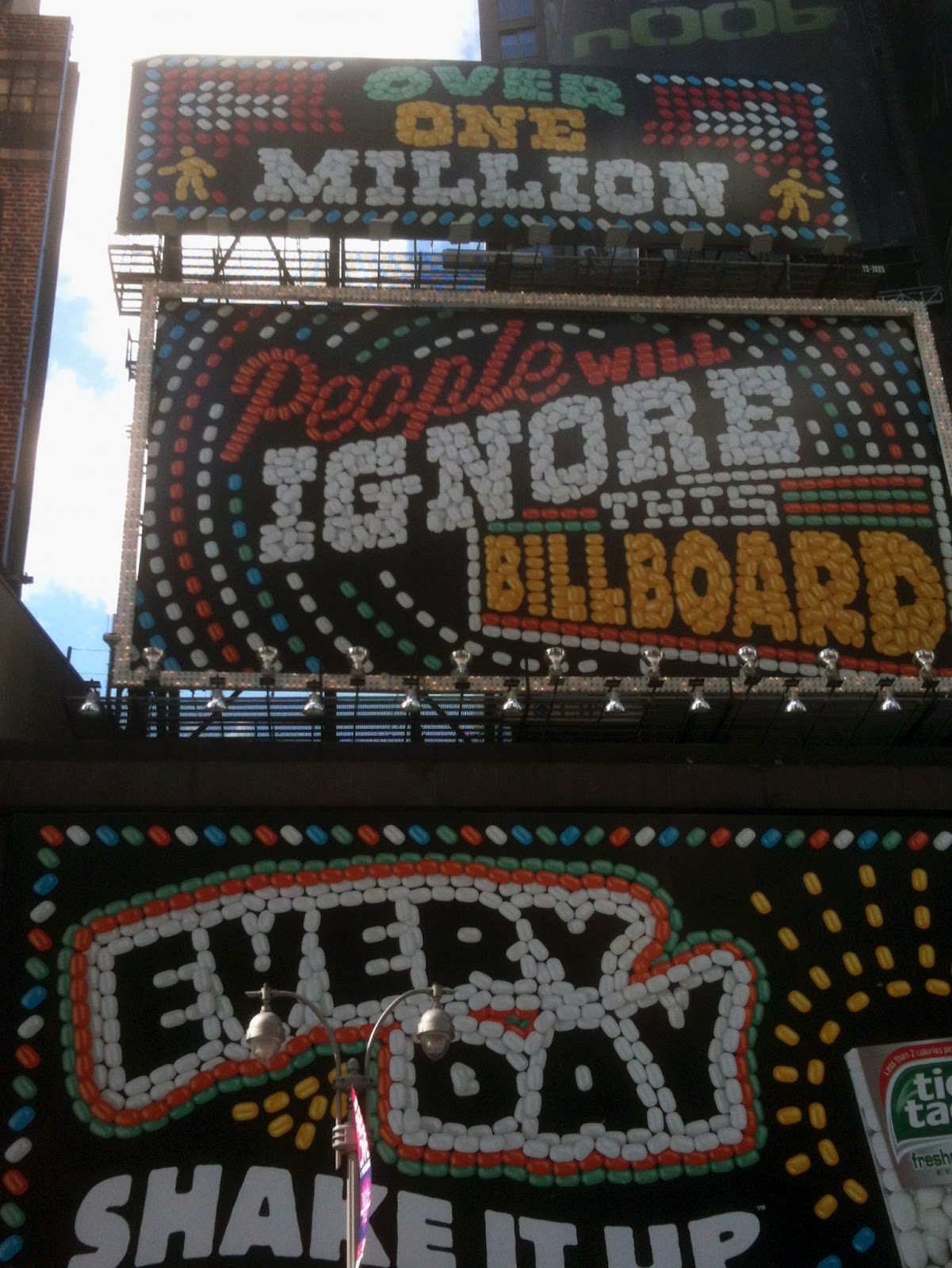
Another thing I notice is that even though this is the middle of Times Square, few people seem to be looking up at the billboards that surround them. The makers of Tic Tacs seem to have seized upon this fact, as their signage somewhat proudly announces the fact that "over one million people will ignore this billboard every day." Not sure how successful an advertising strategy this is, but it's certainly an interesting approach.

Tuesday, February 14, 2012

Gene Weingarten's "Pearls Before Breakfast": A Handy Guide to My Outrage

Although in class I was unable to summarize my feelings of rage towards this article, in speaking with Stefanie afterwards while waiting to talk to Nora I came up with this: because the authors of the study were so worried that they were going to create some sort of mob scene, they limited the parameters in such a way as to all but guarantee the result. This isn't research, imho -- it's stacking the deck. Here is the list of things I wrote out after finishing reading it:

Time of day: ensured that most people would be on their way to work, and less likely or able to stop to listen even if they'd wanted to

Location: somewhat remote Metro stop ensured that most people would be passing through on their way to somewhere else, less likely to loiter

Choice of music: while Bell may be extraordinary musician, classical music is not a particularly popular style of music in 21st century

Culture: the appeal of classical music can be seen as largely cultural, further limiting the number of passersby who might be interested

Class: additionally, the appeal of classical music is also class-based to the extent that attending the opera or symphony can be incredibly expensive

Song selection: by not choosing recognizable selections, they were making it less likely that a crowd would gather and listen together

Children: of course the children were interested -- anything out of the ordinary on an otherwise dull commute would be a welcome diversion

Busking: there is a distinct difference between a musician performing for performance sake & one who is playing in order to get paid by passersby

I could probably write a paragraph about each point, but I think you get my drift. I found a very interesting graph, for instance, which shows that last year classical music albums sold approximately 10 million copies compared to 105 million for rock, 55 million for R&B, 55 million for alternative, 42 million for country and on down the line. The only genre that sold less than classical was new age. From my rough estimate, there are 400 million albums reflected in the graph, which puts classical at 2.5% of the total.

As far as I'm concerned, this rather aptly illustrates the pretty incredible bias that these so-called researchers were working under. Joshua Bell is a talented musician, so went the logic, therefore people will obviously stop to listen to him. If it were Mos Def rapping, or Bruce Springsteen singing, then most certainly yes. But your average person does not listen to classical radio stations or go to the symphony. The class bias here is incredibly obvious and, sadly, laughable.

For me, it wasn't so much a "we're obviously better than you" attitude that Larry mentioned in class, but one of "we can't understand why you're not like us." To which I would reply, "Well, duh." If someone is tuning out a street musician, for whatever reason, at the end of the day it doesn't matter how talented that musician is or how much their instrument is worth. If you don't hear something, you don't hear it -- whether it's extraordinary or downright terrible.

Wednesday, February 1, 2012

Taking on the meaning of "Green" design

In what seems to have become the theme of the day, here's MoMA curator and critic Paola Antonelli on the state of green design at Domus:

However annoying and ideologised, the green cliché has served its purpose, driving into the public consciousness an awareness of the need to change behaviour. It is now time for designers to get rid of the last vestiges of sanctimony and do what they do best: help society's next step towards a new normalcy that incorporates an environmentally responsible attitude in everyday life. It is time for environmentally responsible, fair trade-based, ecological, sustainable, ethical, reduced-footprint, energy-efficient, zero-waste, bioregional, biodegradable, recyclable design to be less ascetic and more human and vulnerable. If outrageousness, especially of the badass kind, is still hard to find (except perhaps in gaudy, speedy, expensive big boys' toys like the Tesla Roadster or the Czeers MK1 solar-powered speedboat...), the real world needs a dose of that kind of thing, too.

There are so many other fantastic quotes -- like "environmentally responsible design should be like dark chocolate: delicious and sensual, yet still good for the health of body and soul" -- that you should really just go ahead and read the whole thing.

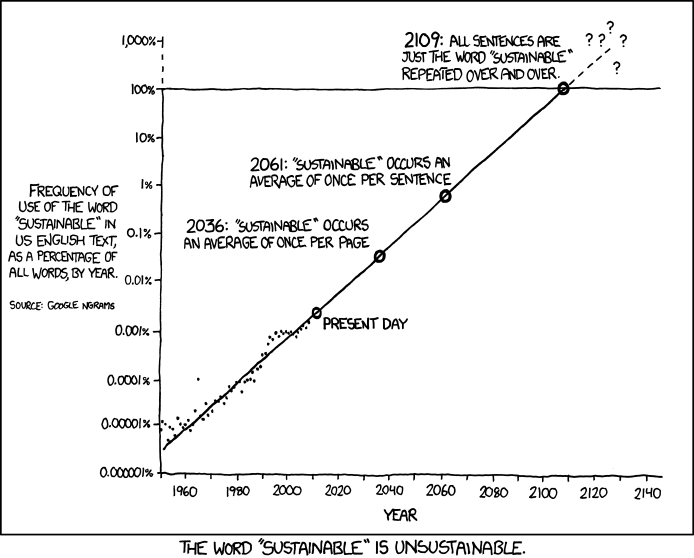
Is the word "sustainable" unsustainable?


So here's a humorous yet troubling graph from xkcd.com which sums up greenwashing quite nicely and also illustrates the incredible hurdles that we will have to overcome in order to appropriately define sustainability. Grazyna & I briefly discussed this in our pre-term meeting -- the idea that we might want to consider avoiding use of the term "sustainability" entirely, since it has been co-opted to such an incredible extent. What do you think? Can we salvage the word and make it mean something again, or should we search for an alternate way to describe what encompasses a sustainable future?

Saturday, January 28, 2012

In SF, a New Kind of Public Space

It looks like they're starting to address outdoor public seating in San Francisco, at least to a degree. In Sunday's New York Times article called A Renewed Public Push for Somewhere to Sit Outdoors, the issue is raised in relation to the emergence of miniparks, called "parklets," which have started to appear in various places throughout the city. They are often found, for instance, near areas where foodtrucks congregate and contain either permanent or removable furniture.

According to the article, "This resurgence has reignited the debate over public space and homelessness. Scott Wiener, a supervisor who represents the Castro, has introduced legislation to prohibit people from smoking, camping or parking shopping carts in Jane Warner Plaza and nearby Harvey Milk Plaza. The legislation, which Mr. Wiener said could be expanded to cover parklets across the city, has been met by an outcry from some old-time Castro leaders and advocates for the homeless."

So they're trotting out the well-worn homeless argument, and it's quite a shame - parklets seem a lot like what's been happening in our new pedestrian plazas along Broadway, both in Midtown and north of Union Square. Hopefully SF can figure out a solution, because “there is a pretty broad agreement that depriving the public of seating is not going to solve the problem of who has access to public spaces.” Hear hear!

Wednesday, December 7, 2011

Skyway

So in class on Monday we briefly talked about skyways, and having lived in Minneapolis for four years I used them with some frequency--although the downtown restaurant in which I worked was connected to a parking garage and so I didn't use them every day. I was reminded of the lyrics to the classic Replacements song "Skyway." Here they are:

You take the skyway, high above the busy little one-way
In my stupid hat and gloves, at night I lie awake
Wonderin’ if I’ll sleep
Wonderin’ if we’ll meet out in the street

But you take the skyway

It don’t move at all like a subway
It’s got bums when it’s cold like any other place
It’s warm up inside
Sittin’ down and waitin’ for a ride

Beneath the skyway

Oh, then one day, I saw you walkin’ down that little one-way
Where, the place I’d catch my ride most everyday
There wasn’t a damn thing I could do or say
Up in the skyway

Monday, November 21, 2011

Lit Review

We know that one facet of green building is to better protect the health and welfare of the inhabitants of the built environment over traditional construction methods, given its concern with unnecessary exposure to chemicals and the improvement of indoor air quality among others. But what effect does knowing that a space was built with these things in mind have in making people feel appreciably better? Is there any way to know that it's the perception of a healthier built environment that's improving people's health over the fact that the built environment is simply healthier? I guess what I'm proposing to examine is a sustainability placebo effect, if you will, if such a thing is even possible.

To that end, I have started to examine some research which indirectly addresses these topics since I have found very little which directly applies:

Adams, A. (2010). Kids in the atrium: Comparing architectural intentions and children’s experiences in a pediatric hospital lobby. Social Science & Medicine, 70(5), 658-667.

This paper addresses research conducted at The Atrium, an eight-story addition to the Hospital for Sick Children in Toronto completed in 1993, through both a review of architectural documentation and interviews with the atrium’s designers as well as evaluations by children who use the space. The authors place The Atrium in the context of late-twentieth century shopping malls and other consumerist spaces and discuss their findings including the social uses of the space, its role in wayfinding and issues of connectivity and distraction. Although sustainability is not directly addressed, The Atrium contains many things – gardens, ample natural light, visual connection to the outdoors – which can be considered sustainable. They ultimately ask if the role of hospital design is to create healing spaces instead of shopping malls and, if so, what implications this has on the current model of hospital design.

Becker, F. (2008). The Ecology of the Patient Visit: Physical attractiveness, waiting times, and perceived quality of care. The Journal of Ambulatory Care Management, 31(2), 128-141.

I have been familiar with this research for several years now, though this is the first time that I have actually read the article. The research, which involved six clinics – three deemed “attractive” and three “unattractive” by non-design research students prior to the study – at the Weill Cornell Medical Center on the Upper East Side of Manhattan, aimed to discover the connections between actual and perceived waiting times to be seen by a caregiver and both the attractiveness of the spaces as well as an overall impression of the quality of care received. Actual times were recorded by observers over a 15-week period and the others were collected through voluntary surveys returned by patients. Researchers found a significant correlation between physical attractiveness and both overall satisfaction and relief of patient anxiety, as well as a noticeable difference in the perceived versus actual wait times where patients overestimated short wait times and underestimated long wait times. It should be noted that one of the attractive clinics was stated to contain “many sustainable finishes and materials,” although this is the only overt reference to sustainability. This model of research seems particularly exciting, and I can envision a similar survey which seeks to correlate a clinic’s sustainability with perceived quality of care.

Caspari, S. (2006). The aesthetic dimension in hospitals: An investigation into strategic plans. International Journal of Nursing Studies, 43(7), 851-859.

This paper concerns an investigation into the strategic plans of Norwegian general hospitals, where the researchers analyzed the documentation provided to them in order to determine to what extent aesthetics played a role in the design of the buildings and how these issues were ultimately prioritized.  The researchers created a matrix of ‘aesthetic categories’ – harmony, food, art, rooms, light, colors, design, sound, nature, aesthetics and quality (aesthetics was given its own category to chart specific mentions of the term) – each with its own subcategories, and noted mentions of each in the strategic plans. They concluded that all categories were significantly underrepresented (“almost absent”), though it should be noted that just because these categories were not overtly mentioned does not mean that they were not considered during the design process. However, this model of research does present a potentially interesting way to investigate mentions of sustainability in strategic planning and to what end such mentions may lead.

Shepley, M. (2009). Eco-effective design and evidence-based design: Perceived synergy and conflict. Health Environments Research and Design Journal, 2(3), 56-70.

While this article should prove to be extremely valuable, the copy which I received via inter-library loan is almost unreadable and I hope to be able to obtain a better copy soon. From what little I’ve been able to read without getting a headache, the authors attempt to address the intersection of eco-effective design and evidence-based design and determine both the amount of overlap (which seems substantial) and its ultimate result (either supportive or in conflict). If I may quote: “Though a number of studies that assess either sustainability in the built environment or the relationship between building design and health outcomes have been completed recently or are currently underway, few if any studies have addressed both EBD and EED in relation to the other.” I hope to be one of the first!

Ulrich, R. S. (2001). Effects of healthcare environmental design on medical outcomes. In A. Dilani (Ed.) Design and Health: Proceedings of the Second International Conference on Health and Design (pp. 49–59). Stockholm, Sweden: Svensk Byggtjanst.

This conference paper by Ulrich is the most thorough of a series of articles and lectures given on a similar topic; namely, a review of the existing research available at the time concerning environmental characteristics which influence health outcomes and an attempt to formulate a broad theory of “supportive healthcare design” which addresses these issues. Ulrich touches on the usual suspects – noise, views to nature, adequate sunlight, room occupancy size, flooring materials, furniture arrangements – in order to demonstrate that there is a growing body of knowledge which can be used to formulate an active method of design which fosters control, promotes social support and provides access to nature. It is interesting that Ulrich never overtly addresses the issue of sustainability, although one could argue that an environmental sensitivity exists in his theorizing.

Saturday, November 19, 2011

Concrete State of Mind

Last Wednesday, Transportation Alternatives hosted a breakfast panel discussion at the NYU Wagner Rudin Center for Transportation Policy & Management. Opening remarks were given by Paul Steely White, the executive director of TA, and he relayed some interesting facts that I hadn't heard before: NYC streets make up fully one-quarter of the land area of the city and account for 80% of its open space. He also mentioned that there has been a 40-60% reduction in nitrogen oxide emissions in Times Square since the pedestrian plaza was established, and the city is piloting 20-mph zones in residential areas in the Bronx.

Each panelist gave a short presentation before they sat down together to discuss some broader topics. The moderator for this was Matt Seaton, who is the editor of "comment is free America" at The Guardian and an author of several books on the experience and public image of bicycling, including his latest "Two Wheels: Thoughts from the Bike Lane." The first panelist to speak was Andrew Mondschein, an adjunct assistant professor of urban planning at NYU Wagner, who spoke about some of his research with the Rudin Center.

His presentation, called "Why We Walk: Social, Economic, and Cognitive Benefits," discussed the differences between cognitively "active" travelers, like drivers and walkers, and "passive" travelers, who are passengers in vehicles and on public transportation. It may come as no surprise that the active travelers, when queried, know significantly more about their environment and surroundings. But the part of his brief lecture which I found most fascinating was this graph, which charts the percentage of trips taken by mode and income-education level for both lower- and higher-density areas:


On the right is the graph for high-density cities, like NYC, and it shows that at the opposite ends of the socio-economic spectrum both the poorest ("0" on the left) and the wealthiest ("8" on the right) walk (in pink) about the same amounts. The poor walk because they have to, while the wealthy walk because they can -- but what about those in the middle? That's where Mondschein will be focusing future research.

Dr. Mindy Thompson Fullilove, professor and research psychiatrist at Columbia University Medical Center, spoke about "Main Streets and Mental Health" including her research on main streets in New Jersey, where she hopes to visit 100 main streets in NJ and elsewhere to document the connection between healthy street life and positive mental health. She spoke about how main streets serve as "crossroads," and how crossroads "allow people to develop casual connections and permit people to consult on problems and solutions." She detailed the destruction of one main street in Asheville, NC and the negative consequences it had on the mostly African-American population living there.

Claire Fellman, a landscape architect at Snohetta in NYC, talked about the master plan for a permanent pedestrian plaza in Times Square which will replace the temporary plaza there now with the movable tables and chairs and remnants of curbs from former streets. She said some interesting things, like how they decided to look at this space -- which stretches from 42nd to 47th Streets along Broadway and sees over 500,000 people pass through each day -- "as a sort of room," though she didn't explain this further other than to suggest that they were carefully looking at circulation patterns and zones of activity.

She also noted how "small elevations serve as stages," and that Snohetta will most likely incorporate some sort of structure of levels into the design in order to foster public spectacle. Another thing she noted is that, unlike in the past, signage significantly affects where people gather -- probably because of its electronic and interactive nature. They also thought about collective memory, according to Fellman: "What is Times Square?" is a question they kept coming back to, in order to get to the essence of what the space should be. (Unfortunately, the slides she showed of the renderings were not made available, and I can only assume that they won't be.)

In the end, more questions were probably raised than answers given, though I guess this is to be somewhat expected. It almost devolved into an argument about cyclists vs. pedestrians during the Q&A, but in her closing remarks Jennifer So Godenzo, the pedestrian advocacy manager for TA, reminded everyone that what's important is that we continue to reclaim roads for all alternative modes of transportation and that it comes from those spaces formerly reserved for only vehicular traffic. Rates of bicycling are doubling each year in NYC, and the infrastructure will need to support this growth.

Projecting Climate Change

The New York State Energy Research and Development Authority (NYSERDA) just released the results of a three-year-long study which projects what changes the New York climate will undergo during the rest of this century. According to The New York Times:
Its authors say it is the most detailed study that looks at how changes brought about by a warming Earth — from rising temperatures to more precipitation and global sea level rise — will affect the economy, the ecology and even the social fabric of the state.
The report is supposedly 600 pages long, but the link above goes to a summary report which is only 60 pages. In general, it's incredibly depressing — but maybe it can be used as an effective tool to convince people that we need to start addressing these issues immediately.