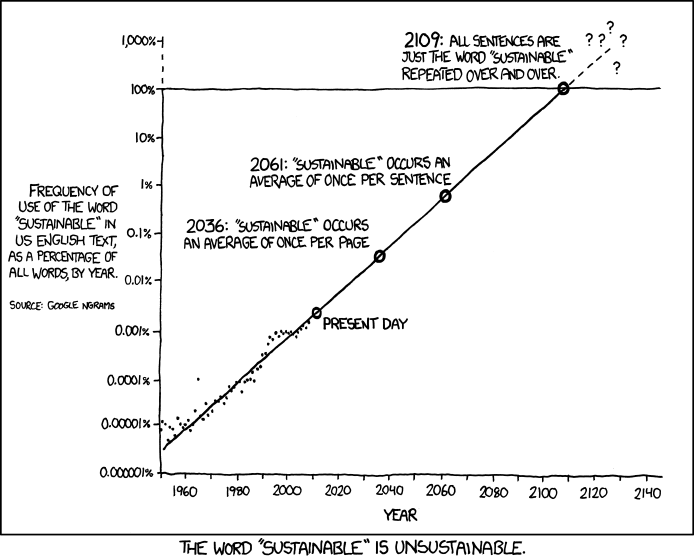
So here's a humorous yet troubling graph from xkcd.com which sums up greenwashing quite nicely and also illustrates the incredible hurdles that we will have to overcome in order to appropriately define sustainability. Grazyna & I briefly discussed this in our pre-term meeting -- the idea that we might want to consider avoiding use of the term "sustainability" entirely, since it has been co-opted to such an incredible extent. What do you think? Can we salvage the word and make it mean something again, or should we search for an alternate way to describe what encompasses a sustainable future?
Wednesday, February 1, 2012
Is the word "sustainable" unsustainable?
So here's a humorous yet troubling graph from xkcd.com which sums up greenwashing quite nicely and also illustrates the incredible hurdles that we will have to overcome in order to appropriately define sustainability. Grazyna & I briefly discussed this in our pre-term meeting -- the idea that we might want to consider avoiding use of the term "sustainability" entirely, since it has been co-opted to such an incredible extent. What do you think? Can we salvage the word and make it mean something again, or should we search for an alternate way to describe what encompasses a sustainable future?
Saturday, January 28, 2012
In SF, a New Kind of Public Space
It looks like they're starting to address outdoor public seating in San Francisco, at least to a degree. In Sunday's New York Times article called A Renewed Public Push for Somewhere to Sit Outdoors, the issue is raised in relation to the emergence of miniparks, called "parklets," which have started to appear in various places throughout the city. They are often found, for instance, near areas where foodtrucks congregate and contain either permanent or removable furniture.
According to the article, "This resurgence has reignited the debate over public space and homelessness. Scott Wiener, a supervisor who represents the Castro, has introduced legislation to prohibit people from smoking, camping or parking shopping carts in Jane Warner Plaza and nearby Harvey Milk Plaza. The legislation, which Mr. Wiener said could be expanded to cover parklets across the city, has been met by an outcry from some old-time Castro leaders and advocates for the homeless."
So they're trotting out the well-worn homeless argument, and it's quite a shame - parklets seem a lot like what's been happening in our new pedestrian plazas along Broadway, both in Midtown and north of Union Square. Hopefully SF can figure out a solution, because “there is a pretty broad agreement that depriving the public of seating is not going to solve the problem of who has access to public spaces.” Hear hear!
According to the article, "This resurgence has reignited the debate over public space and homelessness. Scott Wiener, a supervisor who represents the Castro, has introduced legislation to prohibit people from smoking, camping or parking shopping carts in Jane Warner Plaza and nearby Harvey Milk Plaza. The legislation, which Mr. Wiener said could be expanded to cover parklets across the city, has been met by an outcry from some old-time Castro leaders and advocates for the homeless."
So they're trotting out the well-worn homeless argument, and it's quite a shame - parklets seem a lot like what's been happening in our new pedestrian plazas along Broadway, both in Midtown and north of Union Square. Hopefully SF can figure out a solution, because “there is a pretty broad agreement that depriving the public of seating is not going to solve the problem of who has access to public spaces.” Hear hear!
Wednesday, December 7, 2011
Skyway
So in class on Monday we briefly talked about skyways, and having lived in Minneapolis for four years I used them with some frequency--although the downtown restaurant in which I worked was connected to a parking garage and so I didn't use them every day. I was reminded of the lyrics to the classic Replacements song "Skyway." Here they are:
You take the skyway, high above the busy little one-way
In my stupid hat and gloves, at night I lie awake
Wonderin’ if I’ll sleep
Wonderin’ if we’ll meet out in the street
But you take the skyway
It don’t move at all like a subway
It’s got bums when it’s cold like any other place
It’s warm up inside
Sittin’ down and waitin’ for a ride
Beneath the skyway
Oh, then one day, I saw you walkin’ down that little one-way
Where, the place I’d catch my ride most everyday
There wasn’t a damn thing I could do or say
Up in the skyway
You take the skyway, high above the busy little one-way
In my stupid hat and gloves, at night I lie awake
Wonderin’ if I’ll sleep
Wonderin’ if we’ll meet out in the street
But you take the skyway
It don’t move at all like a subway
It’s got bums when it’s cold like any other place
It’s warm up inside
Sittin’ down and waitin’ for a ride
Beneath the skyway
Oh, then one day, I saw you walkin’ down that little one-way
Where, the place I’d catch my ride most everyday
There wasn’t a damn thing I could do or say
Up in the skyway
Monday, November 21, 2011
Lit Review
We know that one facet of green building is to better protect the health
and welfare of the inhabitants of the built environment over
traditional construction methods, given its concern with unnecessary
exposure to chemicals and the improvement of indoor air quality among
others. But what effect does knowing that a space was built with these
things in mind have in making people feel appreciably better? Is there
any way to know that it's the perception of a healthier built
environment that's improving people's health over the fact that the
built environment is simply healthier? I guess what I'm proposing to
examine is a sustainability placebo effect, if you will, if such a thing
is even possible.
To that end, I have started to examine some research which indirectly addresses these topics since I have found very little which directly applies:
Adams, A. (2010). Kids in the atrium:
Comparing architectural intentions and children’s experiences in a pediatric
hospital lobby. Social Science & Medicine, 70(5), 658-667.
This paper addresses
research conducted at The Atrium, an eight-story addition to the Hospital for
Sick Children in Toronto
completed in 1993, through both a review of architectural documentation and
interviews with the atrium’s designers as well as evaluations by children who
use the space. The authors place The Atrium in the context of late-twentieth
century shopping malls and other consumerist spaces and discuss their findings
including the social uses of the space, its role in wayfinding and issues of
connectivity and distraction. Although sustainability is not directly
addressed, The Atrium contains many things – gardens, ample natural light,
visual connection to the outdoors – which can be considered sustainable. They
ultimately ask if the role of hospital design is to create healing spaces instead of shopping malls and,
if so, what implications this has on the current model of hospital design.
Becker, F. (2008). The Ecology of the Patient
Visit: Physical attractiveness, waiting times, and perceived quality of care. The
Journal of Ambulatory Care Management, 31(2), 128-141.
I have been familiar
with this research for several years now, though this is the first time that I
have actually read the article. The research, which involved six clinics –
three deemed “attractive” and three “unattractive” by non-design research
students prior to the study – at the Weill Cornell Medical Center on the Upper
East Side of Manhattan, aimed to discover the connections between actual and
perceived waiting times to be seen by a caregiver and both the attractiveness of
the spaces as well as an overall impression of the quality of care received.
Actual times were recorded by observers over a 15-week period and the others
were collected through voluntary surveys returned by patients. Researchers
found a significant correlation between physical attractiveness and both
overall satisfaction and relief of patient anxiety, as well as a noticeable
difference in the perceived versus actual wait times where patients
overestimated short wait times and underestimated long wait times. It should be
noted that one of the attractive clinics was stated to contain “many
sustainable finishes and materials,” although this is the only overt reference
to sustainability. This model of research seems particularly exciting, and I
can envision a similar survey which seeks to correlate a clinic’s sustainability
with perceived quality of care.
Caspari, S. (2006). The aesthetic dimension in
hospitals: An investigation into strategic plans. International Journal of
Nursing Studies, 43(7), 851-859.
This paper concerns
an investigation into the strategic plans of Norwegian general hospitals, where
the researchers analyzed the documentation provided to them in order to
determine to what extent aesthetics played a role in the design of the
buildings and how these issues were ultimately prioritized. The researchers created a matrix of
‘aesthetic categories’ – harmony, food, art, rooms, light, colors, design,
sound, nature, aesthetics and quality (aesthetics was given its own category to
chart specific mentions of the term) – each with its own subcategories, and noted
mentions of each in the strategic plans. They concluded that all categories
were significantly underrepresented (“almost absent”), though it should be
noted that just because these categories were not overtly mentioned does not
mean that they were not considered during the design process. However, this
model of research does present a potentially interesting way to investigate
mentions of sustainability in strategic planning and to what end such mentions
may lead.
Shepley, M. (2009). Eco-effective design and
evidence-based design: Perceived synergy and conflict. Health Environments Research
and Design Journal, 2(3), 56-70.
While this article
should prove to be extremely valuable, the copy which I received via inter-library
loan is almost unreadable and I hope to be able to obtain a better copy soon.
From what little I’ve been able to read without getting a headache, the authors
attempt to address the intersection of eco-effective design and evidence-based
design and determine both the amount of overlap (which seems substantial) and
its ultimate result (either supportive or in conflict). If I may quote: “Though
a number of studies that assess either sustainability in the built environment
or the relationship between building design and health outcomes have been
completed recently or are currently underway, few if any studies have addressed
both EBD and EED in relation to the other.” I hope to be one of the first!
Ulrich, R. S. (2001). Effects of healthcare
environmental design on medical outcomes. In A. Dilani (Ed.) Design and Health:
Proceedings of the Second International Conference on Health and Design (pp.
49–59). Stockholm, Sweden: Svensk Byggtjanst.
This conference paper
by Ulrich is the most thorough of a series of articles and lectures given on a
similar topic; namely, a review of the existing research available at the time
concerning environmental characteristics which influence health outcomes and an
attempt to formulate a broad theory of “supportive healthcare design” which
addresses these issues. Ulrich touches on the usual suspects – noise, views to
nature, adequate sunlight, room occupancy size, flooring materials, furniture
arrangements – in order to demonstrate that there is a growing body of
knowledge which can be used to formulate an active method of design which
fosters control, promotes social support and provides access to nature. It is
interesting that Ulrich never overtly addresses the issue of sustainability,
although one could argue that an environmental sensitivity exists in his theorizing.
Sunday, November 20, 2011
Saturday, November 19, 2011
Concrete State of Mind
Last Wednesday, Transportation Alternatives hosted a breakfast panel discussion at the NYU Wagner Rudin Center for Transportation Policy & Management. Opening remarks were given by Paul Steely White, the executive director of TA, and he relayed some interesting facts that I hadn't heard before: NYC streets make up fully one-quarter of the land area of the city and account for 80% of its open space. He also mentioned that there has been a 40-60% reduction in nitrogen oxide emissions in Times Square since the pedestrian plaza was established, and the city is piloting 20-mph zones in residential areas in the Bronx.
Each panelist gave a short presentation before they sat down together to discuss some broader topics. The moderator for this was Matt Seaton, who is the editor of "comment is free America" at The Guardian and an author of several books on the experience and public image of bicycling, including his latest "Two Wheels: Thoughts from the Bike Lane." The first panelist to speak was Andrew Mondschein, an adjunct assistant professor of urban planning at NYU Wagner, who spoke about some of his research with the Rudin Center.
His presentation, called "Why We Walk: Social, Economic, and Cognitive Benefits," discussed the differences between cognitively "active" travelers, like drivers and walkers, and "passive" travelers, who are passengers in vehicles and on public transportation. It may come as no surprise that the active travelers, when queried, know significantly more about their environment and surroundings. But the part of his brief lecture which I found most fascinating was this graph, which charts the percentage of trips taken by mode and income-education level for both lower- and higher-density areas:
On the right is the graph for high-density cities, like NYC, and it shows that at the opposite ends of the socio-economic spectrum both the poorest ("0" on the left) and the wealthiest ("8" on the right) walk (in pink) about the same amounts. The poor walk because they have to, while the wealthy walk because they can -- but what about those in the middle? That's where Mondschein will be focusing future research.
Dr. Mindy Thompson Fullilove, professor and research psychiatrist at Columbia University Medical Center, spoke about "Main Streets and Mental Health" including her research on main streets in New Jersey, where she hopes to visit 100 main streets in NJ and elsewhere to document the connection between healthy street life and positive mental health. She spoke about how main streets serve as "crossroads," and how crossroads "allow people to develop casual connections and permit people to consult on problems and solutions." She detailed the destruction of one main street in Asheville, NC and the negative consequences it had on the mostly African-American population living there.
Claire Fellman, a landscape architect at Snohetta in NYC, talked about the master plan for a permanent pedestrian plaza in Times Square which will replace the temporary plaza there now with the movable tables and chairs and remnants of curbs from former streets. She said some interesting things, like how they decided to look at this space -- which stretches from 42nd to 47th Streets along Broadway and sees over 500,000 people pass through each day -- "as a sort of room," though she didn't explain this further other than to suggest that they were carefully looking at circulation patterns and zones of activity.
She also noted how "small elevations serve as stages," and that Snohetta will most likely incorporate some sort of structure of levels into the design in order to foster public spectacle. Another thing she noted is that, unlike in the past, signage significantly affects where people gather -- probably because of its electronic and interactive nature. They also thought about collective memory, according to Fellman: "What is Times Square?" is a question they kept coming back to, in order to get to the essence of what the space should be. (Unfortunately, the slides she showed of the renderings were not made available, and I can only assume that they won't be.)
In the end, more questions were probably raised than answers given, though I guess this is to be somewhat expected. It almost devolved into an argument about cyclists vs. pedestrians during the Q&A, but in her closing remarks Jennifer So Godenzo, the pedestrian advocacy manager for TA, reminded everyone that what's important is that we continue to reclaim roads for all alternative modes of transportation and that it comes from those spaces formerly reserved for only vehicular traffic. Rates of bicycling are doubling each year in NYC, and the infrastructure will need to support this growth.
Each panelist gave a short presentation before they sat down together to discuss some broader topics. The moderator for this was Matt Seaton, who is the editor of "comment is free America" at The Guardian and an author of several books on the experience and public image of bicycling, including his latest "Two Wheels: Thoughts from the Bike Lane." The first panelist to speak was Andrew Mondschein, an adjunct assistant professor of urban planning at NYU Wagner, who spoke about some of his research with the Rudin Center.
His presentation, called "Why We Walk: Social, Economic, and Cognitive Benefits," discussed the differences between cognitively "active" travelers, like drivers and walkers, and "passive" travelers, who are passengers in vehicles and on public transportation. It may come as no surprise that the active travelers, when queried, know significantly more about their environment and surroundings. But the part of his brief lecture which I found most fascinating was this graph, which charts the percentage of trips taken by mode and income-education level for both lower- and higher-density areas:
On the right is the graph for high-density cities, like NYC, and it shows that at the opposite ends of the socio-economic spectrum both the poorest ("0" on the left) and the wealthiest ("8" on the right) walk (in pink) about the same amounts. The poor walk because they have to, while the wealthy walk because they can -- but what about those in the middle? That's where Mondschein will be focusing future research.
Dr. Mindy Thompson Fullilove, professor and research psychiatrist at Columbia University Medical Center, spoke about "Main Streets and Mental Health" including her research on main streets in New Jersey, where she hopes to visit 100 main streets in NJ and elsewhere to document the connection between healthy street life and positive mental health. She spoke about how main streets serve as "crossroads," and how crossroads "allow people to develop casual connections and permit people to consult on problems and solutions." She detailed the destruction of one main street in Asheville, NC and the negative consequences it had on the mostly African-American population living there.
Claire Fellman, a landscape architect at Snohetta in NYC, talked about the master plan for a permanent pedestrian plaza in Times Square which will replace the temporary plaza there now with the movable tables and chairs and remnants of curbs from former streets. She said some interesting things, like how they decided to look at this space -- which stretches from 42nd to 47th Streets along Broadway and sees over 500,000 people pass through each day -- "as a sort of room," though she didn't explain this further other than to suggest that they were carefully looking at circulation patterns and zones of activity.
She also noted how "small elevations serve as stages," and that Snohetta will most likely incorporate some sort of structure of levels into the design in order to foster public spectacle. Another thing she noted is that, unlike in the past, signage significantly affects where people gather -- probably because of its electronic and interactive nature. They also thought about collective memory, according to Fellman: "What is Times Square?" is a question they kept coming back to, in order to get to the essence of what the space should be. (Unfortunately, the slides she showed of the renderings were not made available, and I can only assume that they won't be.)
In the end, more questions were probably raised than answers given, though I guess this is to be somewhat expected. It almost devolved into an argument about cyclists vs. pedestrians during the Q&A, but in her closing remarks Jennifer So Godenzo, the pedestrian advocacy manager for TA, reminded everyone that what's important is that we continue to reclaim roads for all alternative modes of transportation and that it comes from those spaces formerly reserved for only vehicular traffic. Rates of bicycling are doubling each year in NYC, and the infrastructure will need to support this growth.
Projecting Climate Change
The New York State Energy Research and Development Authority (NYSERDA) just released the results of a three-year-long study which projects what changes the New York climate will undergo during the rest of this century. According to The New York Times:
Its authors say it is the most detailed study that looks at how changes brought about by a warming Earth — from rising temperatures to more precipitation and global sea level rise — will affect the economy, the ecology and even the social fabric of the state.The report is supposedly 600 pages long, but the link above goes to a summary report which is only 60 pages. In general, it's incredibly depressing — but maybe it can be used as an effective tool to convince people that we need to start addressing these issues immediately.
Wednesday, November 16, 2011
Can Design Influence Memory?
According to a recent study in The Quarterly Journal of Experimental Psychology, the reason you sometimes find yourself forgetting what you're looking for might have more to do with architecture than you realize. It seems that memory is affected by the number of rooms and doorways that you travel through:
When Professor Radvansky gave a group of students a series of different colored objects to remember, and then asked them to either cross a room or pass through a doorway into another room, the subjects showed differences in memory. Even though the participants traveled the exact same distances, they exhibited a decline in memory when they went through a doorway.The researchers think this has something to do with the fact that we "construct mental narratives to organize and retain information" and, according to the article:
When we cross through an event boundary we parse one event into two. Next, we foreground the most current event. If we then try to retrieve information that was carried over the event horizon, the two events compete and interfere with each other.Interesting stuff!
Sunday, November 13, 2011
Time-Lapse View from Space
If you get home from class some night & you're particularly depressed about the state of the world, take five minutes and watch this video processed and edited by Michael Konig -- it will help remind you why our planet is totally worth fighting for.
Dorm vs. Suburbs
Straight out of our last classroom discussion, here's an interesting article in today's New York Times about students in California who are renting McMansions out in the suburbs instead of living in the dorms. Of course, they have to drive to get to school instead of walk or bike -- but the allure of a backyard pool and working on your laptop in the Jacuzzi (see hilarious photo) has got to be pretty strong.
Subscribe to:
Posts (Atom)

