Wednesday, March 14, 2012
Baby in a Hazmat Suit!
In an article in the NY Times Home section called "Is It Safe to Play Yet? Going to Extreme Lengths to Purge Household Toxins". Good article, great picture.

Monday, March 12, 2012
Cows Are Important
Americans are eating less meat, and this is incredibly good news for a number of reasons. It means that fewer natural resources are being consumed in order to produce more meat, and it also hopefully means that people are making healthier eating choices (the article suggests that health is the main reason people are making the switch, but I have a suspicion that the cost of meat is a large factor as well). But a 12% drop in the last five years? That's pretty remarkable.
As a pesco-vegetarian (pescartarian?) for the last 15+ years, it heartens me to think that people are taking something like Meatless Mondays seriously. And I hope that Meatless Mondays can eventually become meatless weekends or weekdays for whole groups of people. Veggies are delicious, and cows are important -- don't ever forget that! Oh, and this: Eating red meat is associated with a sharply increased risk of death from cancer and heart disease, according to a new study. Just saying!
As a pesco-vegetarian (pescartarian?) for the last 15+ years, it heartens me to think that people are taking something like Meatless Mondays seriously. And I hope that Meatless Mondays can eventually become meatless weekends or weekdays for whole groups of people. Veggies are delicious, and cows are important -- don't ever forget that! Oh, and this: Eating red meat is associated with a sharply increased risk of death from cancer and heart disease, according to a new study. Just saying!
Sunday, March 11, 2012
Sara Caples, Architect
I thought that Sara
Caples, of Caples Jefferson Architects, had many interesting things to say
about sustainable design when she came to speak at our research seminar. She talked about how it relates to both residences as well as
institutions like museums and other cultural spaces. I took four main points
away from her talk:
Having more goals results in a “richer
product.” The more stated
goals that a particular project has will undoubtedly produce a building that is
“richer” in the sense that each stated goal brings with it a set of standards
which must be met in order to foster a particular end result. The marriage of
multiple goals, especially when they encompass things like building
community-based initiatives into projects or utilizing modern fabrication
techniques to consume less energy, leads directly to a finished project which
benefits from a wealth of positive intentions.
The forgotten dimension of time. Designers are often too focused on the three
dimensions of space, where length, width and depth exist in a state of relative
stasis without the interaction of time, the fourth dimension. One way to
include time into projects is to maximize daylight, which allows the
inhabitants of a given space to experience the passage of time through the
movement of sunlight. Bringing sunlight down into the bowels of an otherwise
windowless office allows the occupants to connect to the outside environment
and enjoy the benefits that this connection fosters.
Marrying sustainable design objectives to
spiritual and social aspects.
Emotions are also an important factor in successful design, and incorporating
spiritual, social and cultural aspects into a project allows the end users of a
space to connect to it on a deeper level. It is when a building can effectively
“speak” to its inhabitants that something above and beyond design has occurred,
and this is an effective way to incorporate sustainability by making the space
indispensable and meaningful to its occupants.
Local climates are important in sustainable design. Without specifically saying so, many points
that Ms. Caples made about local connections to climate and culture seem to
fall under the concept of “bioregionalism,” a theory which states that humans
inevitably interact with and are affected by the specific location which they
inhabit. It’s this complex relationship between human culture, governmental
bodies and the natural world which can be seen to impact local architecture and
design to the extent that historical practices are often “best practices” and
an area’s specific ecology can almost always suggest solutions that are both
practical as well as sustainable.
Questions on the Readings
Glass, I., Updike, N., Spiegel, A., & Snyder, J. (Producers). (1998, September 4). Mapping [Episode 110]. This American Life Podcast. Podcast retrieved from http://www.thisamericanlife.org/radio-archives/episode/110/mapping
A perfect example of This American Life at its best: a thoughtful collection of essays built around a simple, straightforward topic. Although I felt like they started to run out of steam a bit by the end, the first several entries were remarkably strong and incredibly interesting. At first I was most fascinated by the guy who makes maps of all sorts of things, and his contention that "there isn't anything you can't map."
But then I got to the part about mapping sound, and I started to get a bit uncomfortable when the interviewee began explaining how different chords are associated with different moods and how the Catholic church, among others, has decided what different sounds "mean." As the narrator explained:
Childress, H. (2010). “Noun, Verb, Motive, Context: Research Methods for the Rest of Us.” Unpublished Manuscript, Boston, MA.
I have more of a comment than a question here, mainly about his point that "research extends what we know." Surely this is true, but I would go one step further and say that "research extends both what we know and what we don't know." That is, all research isn't going to produce the answers we're expecting or, for that matter, any answers at all. But not getting any answers to a question can be as informative as getting a bunch of them, possibly more so. And it isn't necessarily because we looked in the wrong place, or asked the wrong question, or deduced an incorrect motive -- maybe there's no answer because of wicked problems. Childress, while mentioning them, doesn't really address how they could end up causing an impasse (though, admittedly, this isn't the point of his article). Would a de facto conclusion be that any research question which attempts to address wicked problems is doomed from the start? This is where he loses me a little bit.
A perfect example of This American Life at its best: a thoughtful collection of essays built around a simple, straightforward topic. Although I felt like they started to run out of steam a bit by the end, the first several entries were remarkably strong and incredibly interesting. At first I was most fascinated by the guy who makes maps of all sorts of things, and his contention that "there isn't anything you can't map."
But then I got to the part about mapping sound, and I started to get a bit uncomfortable when the interviewee began explaining how different chords are associated with different moods and how the Catholic church, among others, has decided what different sounds "mean." As the narrator explained:
Now that I can't stop hearing it, I wonder if every exercise in mapping is really such a good thing. When I sat at my keyboard composing these lines, the computer hum and fan were droning a minor third at me, an interval associated with sorrow. Before Columbus's day, the old maps simply showed an arrow pointing to the mysterious West, and then the words, "there dragons be." Maybe not every terra incognita needs discovering. But, of course, this is America. We don't just explore, we profit. Any day now, I expect a house tuner to be ringing my doorbell, some failed telemarketer who'll promise to harmonize the whir of my toaster with the flush of the toilet, and thereby guarantee me an inner peace worthy of the millennium.To which the interviewee replies, "And you could obviously select from -- like you might select from paint chips -- from a variety of different house moods, happy, sad, active anguish in a context of flux." Funnily enough, I had already started thinking about paint colors before he said this, because while a lot has been written about how painting a room different colors can affect mood, a lot of the more recent research on this topic has shown that this is almost purely contextual -- that reaction to color has more to do with individual differences and less to do with overarching generalities. So my question is this: can we ever successfully generalize how things like color, light or sound make people feel?
I have more of a comment than a question here, mainly about his point that "research extends what we know." Surely this is true, but I would go one step further and say that "research extends both what we know and what we don't know." That is, all research isn't going to produce the answers we're expecting or, for that matter, any answers at all. But not getting any answers to a question can be as informative as getting a bunch of them, possibly more so. And it isn't necessarily because we looked in the wrong place, or asked the wrong question, or deduced an incorrect motive -- maybe there's no answer because of wicked problems. Childress, while mentioning them, doesn't really address how they could end up causing an impasse (though, admittedly, this isn't the point of his article). Would a de facto conclusion be that any research question which attempts to address wicked problems is doomed from the start? This is where he loses me a little bit.
Greenwashing
Here's a humorous (and ultimately kind of depressing) little something I found on my Facebook wall - it's a couple of years old, but there are some choice quotes. What's your favorite? Mine's "Look, dolphins!"
Sunday, February 26, 2012
Parklet Observations
 Time: 1:00pm-2:00pm on a Thursday afternoon
Place: Times Square (Broadway from 42nd-47th Streets)
Weather: Unseasonably warm & windy
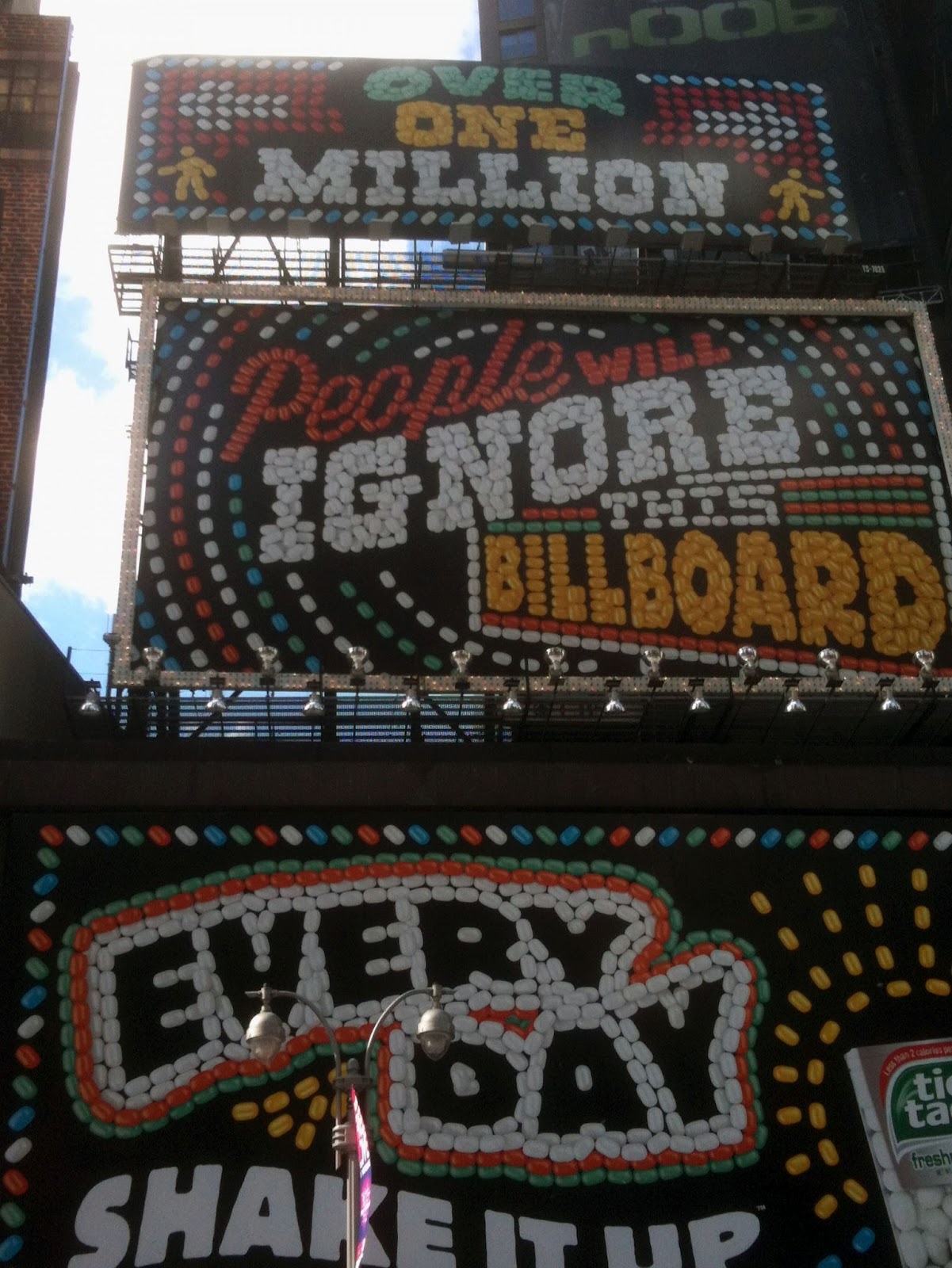
Observations: Approaching the parklet from the south, one of the first things I notice is that while a large portion of the street is now delegated for foot traffic, people still seem to prefer walking on the sidewalks.


Tuesday, February 14, 2012
Gene Weingarten's "Pearls Before Breakfast": A Handy Guide to My Outrage
Although in class I was unable to summarize my feelings of rage towards this article, in speaking with Stefanie afterwards while waiting to talk to Nora I came up with this: because the authors of the study were so worried that they were going to create some sort of mob scene, they limited the parameters in such a way as to all but guarantee the result. This isn't research, imho -- it's stacking the deck. Here is the list of things I wrote out after finishing reading it:
Time of day: ensured that most people would be on their way to work, and less likely or able to stop to listen even if they'd wanted to
Location: somewhat remote Metro stop ensured that most people would be passing through on their way to somewhere else, less likely to loiter
Choice of music: while Bell may be extraordinary musician, classical music is not a particularly popular style of music in 21st century
Culture: the appeal of classical music can be seen as largely cultural, further limiting the number of passersby who might be interested
Class: additionally, the appeal of classical music is also class-based to the extent that attending the opera or symphony can be incredibly expensive
Song selection: by not choosing recognizable selections, they were making it less likely that a crowd would gather and listen together
Children: of course the children were interested -- anything out of the ordinary on an otherwise dull commute would be a welcome diversion
Busking: there is a distinct difference between a musician performing for performance sake & one who is playing in order to get paid by passersby
I could probably write a paragraph about each point, but I think you get my drift. I found a very interesting graph, for instance, which shows that last year classical music albums sold approximately 10 million copies compared to 105 million for rock, 55 million for R&B, 55 million for alternative, 42 million for country and on down the line. The only genre that sold less than classical was new age. From my rough estimate, there are 400 million albums reflected in the graph, which puts classical at 2.5% of the total.
As far as I'm concerned, this rather aptly illustrates the pretty incredible bias that these so-called researchers were working under. Joshua Bell is a talented musician, so went the logic, therefore people will obviously stop to listen to him. If it were Mos Def rapping, or Bruce Springsteen singing, then most certainly yes. But your average person does not listen to classical radio stations or go to the symphony. The class bias here is incredibly obvious and, sadly, laughable.
For me, it wasn't so much a "we're obviously better than you" attitude that Larry mentioned in class, but one of "we can't understand why you're not like us." To which I would reply, "Well, duh." If someone is tuning out a street musician, for whatever reason, at the end of the day it doesn't matter how talented that musician is or how much their instrument is worth. If you don't hear something, you don't hear it -- whether it's extraordinary or downright terrible.
Time of day: ensured that most people would be on their way to work, and less likely or able to stop to listen even if they'd wanted to
Location: somewhat remote Metro stop ensured that most people would be passing through on their way to somewhere else, less likely to loiter
Choice of music: while Bell may be extraordinary musician, classical music is not a particularly popular style of music in 21st century
Culture: the appeal of classical music can be seen as largely cultural, further limiting the number of passersby who might be interested
Class: additionally, the appeal of classical music is also class-based to the extent that attending the opera or symphony can be incredibly expensive
Song selection: by not choosing recognizable selections, they were making it less likely that a crowd would gather and listen together
Children: of course the children were interested -- anything out of the ordinary on an otherwise dull commute would be a welcome diversion
Busking: there is a distinct difference between a musician performing for performance sake & one who is playing in order to get paid by passersby
I could probably write a paragraph about each point, but I think you get my drift. I found a very interesting graph, for instance, which shows that last year classical music albums sold approximately 10 million copies compared to 105 million for rock, 55 million for R&B, 55 million for alternative, 42 million for country and on down the line. The only genre that sold less than classical was new age. From my rough estimate, there are 400 million albums reflected in the graph, which puts classical at 2.5% of the total.
As far as I'm concerned, this rather aptly illustrates the pretty incredible bias that these so-called researchers were working under. Joshua Bell is a talented musician, so went the logic, therefore people will obviously stop to listen to him. If it were Mos Def rapping, or Bruce Springsteen singing, then most certainly yes. But your average person does not listen to classical radio stations or go to the symphony. The class bias here is incredibly obvious and, sadly, laughable.
For me, it wasn't so much a "we're obviously better than you" attitude that Larry mentioned in class, but one of "we can't understand why you're not like us." To which I would reply, "Well, duh." If someone is tuning out a street musician, for whatever reason, at the end of the day it doesn't matter how talented that musician is or how much their instrument is worth. If you don't hear something, you don't hear it -- whether it's extraordinary or downright terrible.
Wednesday, February 1, 2012
Taking on the meaning of "Green" design
In what seems to have become the theme of the day, here's MoMA curator and critic Paola Antonelli on the state of green design at Domus:
There are so many other fantastic quotes -- like "environmentally responsible design should be like dark chocolate: delicious and sensual, yet still good for the health of body and soul" -- that you should really just go ahead and read the whole thing.
However annoying and ideologised, the green cliché has served its purpose, driving into the public consciousness an awareness of the need to change behaviour. It is now time for designers to get rid of the last vestiges of sanctimony and do what they do best: help society's next step towards a new normalcy that incorporates an environmentally responsible attitude in everyday life. It is time for environmentally responsible, fair trade-based, ecological, sustainable, ethical, reduced-footprint, energy-efficient, zero-waste, bioregional, biodegradable, recyclable design to be less ascetic and more human and vulnerable. If outrageousness, especially of the badass kind, is still hard to find (except perhaps in gaudy, speedy, expensive big boys' toys like the Tesla Roadster or the Czeers MK1 solar-powered speedboat...), the real world needs a dose of that kind of thing, too.
There are so many other fantastic quotes -- like "environmentally responsible design should be like dark chocolate: delicious and sensual, yet still good for the health of body and soul" -- that you should really just go ahead and read the whole thing.
Is the word "sustainable" unsustainable?
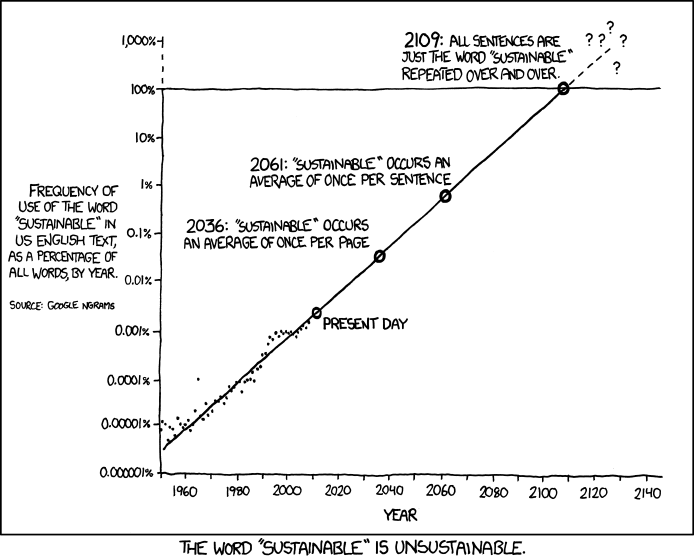
So here's a humorous yet troubling graph from xkcd.com which sums up greenwashing quite nicely and also illustrates the incredible hurdles that we will have to overcome in order to appropriately define sustainability. Grazyna & I briefly discussed this in our pre-term meeting -- the idea that we might want to consider avoiding use of the term "sustainability" entirely, since it has been co-opted to such an incredible extent. What do you think? Can we salvage the word and make it mean something again, or should we search for an alternate way to describe what encompasses a sustainable future?
Saturday, January 28, 2012
In SF, a New Kind of Public Space
It looks like they're starting to address outdoor public seating in San Francisco, at least to a degree. In Sunday's New York Times article called A Renewed Public Push for Somewhere to Sit Outdoors, the issue is raised in relation to the emergence of miniparks, called "parklets," which have started to appear in various places throughout the city. They are often found, for instance, near areas where foodtrucks congregate and contain either permanent or removable furniture.
According to the article, "This resurgence has reignited the debate over public space and homelessness. Scott Wiener, a supervisor who represents the Castro, has introduced legislation to prohibit people from smoking, camping or parking shopping carts in Jane Warner Plaza and nearby Harvey Milk Plaza. The legislation, which Mr. Wiener said could be expanded to cover parklets across the city, has been met by an outcry from some old-time Castro leaders and advocates for the homeless."
So they're trotting out the well-worn homeless argument, and it's quite a shame - parklets seem a lot like what's been happening in our new pedestrian plazas along Broadway, both in Midtown and north of Union Square. Hopefully SF can figure out a solution, because “there is a pretty broad agreement that depriving the public of seating is not going to solve the problem of who has access to public spaces.” Hear hear!
According to the article, "This resurgence has reignited the debate over public space and homelessness. Scott Wiener, a supervisor who represents the Castro, has introduced legislation to prohibit people from smoking, camping or parking shopping carts in Jane Warner Plaza and nearby Harvey Milk Plaza. The legislation, which Mr. Wiener said could be expanded to cover parklets across the city, has been met by an outcry from some old-time Castro leaders and advocates for the homeless."
So they're trotting out the well-worn homeless argument, and it's quite a shame - parklets seem a lot like what's been happening in our new pedestrian plazas along Broadway, both in Midtown and north of Union Square. Hopefully SF can figure out a solution, because “there is a pretty broad agreement that depriving the public of seating is not going to solve the problem of who has access to public spaces.” Hear hear!
Subscribe to:
Posts (Atom)